
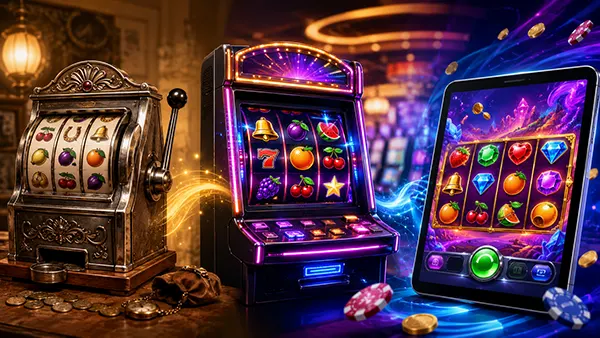
The Evolution of Slots: From Mechanical Machines to Online Games
Slot machines have changed more than almost any other casino game. The earliest models were heavy metal cabinets driven by springs, gears and physical reels, while a modern online slot can run in a mobile browser and contain animated features, several bonus stages and thousands of possible winning patterns. Yet the central idea has remained recognisable: a player places a stake, starts a game cycle and receives a result based on a predefined paytable. The history of slots is therefore not a simple story of old machines being replaced by new ones. Each stage added something that later games retained, from the familiar reel layout and fruit symbols to electronic payouts, video bonuses, progressive jackpots and independently tested random outcomes. By 2026, slots are designed not only around entertainment and convenience but also around clearer information, technical testing and responsible gambling controls.
The Mechanical Origins of Slot Machines
One of the earliest important predecessors appeared in New York in 1891, when Sittman and Pitt produced a coin-operated poker machine. It used five rotating drums carrying 50 playing-card faces. After inserting a coin and pulling a lever, the player tried to form a poker hand. The machine did not normally pay cash by itself because the number of possible poker combinations made an automatic reward mechanism difficult to build. Instead, the owner of a bar or shop could award drinks, cigars or other prizes according to a local paytable. This model established several features that became closely associated with slots: a coin entry, a lever, spinning symbols and an outcome determined by the final position of mechanical parts.
Charles Fey simplified the idea in San Francisco during the 1890s. His Liberty Bell machine used three reels rather than five poker drums and reduced the symbol set to horseshoes, card suits and bells. The smaller number of combinations allowed the cabinet to identify winning lines and release coins automatically. Three Liberty Bell symbols produced the top prize. This was a crucial change because the machine no longer depended on an attendant to interpret every result. The three-reel format was quick to understand, the payout process was direct, and the rules could be shown on the front of the cabinet. These practical qualities helped Fey’s design become the model for many later machines.
Manufacturers soon produced their own versions. Herbert Mills introduced the Operator Bell in the early twentieth century, and machines using cherries, lemons, oranges and plums became common. Fruit symbols were linked to models that dispensed flavoured gum or offered non-cash rewards, partly because gambling restrictions made direct cash prizes difficult in some areas. The familiar BAR symbol is also associated with the Bell-Fruit Gum trade mark. These images remained useful long after the original commercial context had faded because they were bold, easy to print on narrow reel strips and immediately recognisable from a distance. Classic online slots still use them in 2026, showing how visual conventions from mechanical cabinets survived every major technical change.
Why the Lever, Reels and Paytable Lasted
The appeal of an early slot was closely connected to its physical sequence. A player inserted a coin, pulled a lever, heard the internal mechanism move and watched each reel slow to a stop. The result was revealed in stages rather than all at once. This created a short, understandable rhythm that required almost no instruction. The lever also gave the player a clear action, even though it did not provide control over the result. Later machines replaced the lever with a button, but many retained a decorative handle because players associated it with the identity of the game. Even online slots reproduce the same sequence through animated reels, stop sounds and a visible spin control.
Mechanical construction placed strict limits on game design. Each reel carried a fixed strip of symbols, and its stopping positions determined the possible results. A manufacturer could make some symbols appear more often than others by changing their frequency on the strips, but the number of combinations remained restricted by the physical mechanism. Paytables were therefore relatively simple, usually based on one central line and a small set of matching symbols. Cabinets also required regular maintenance because coins could jam, springs could wear and reels could drift out of alignment. These limits encouraged straightforward games, yet they also made the relationship between the visible parts and the result easier for players to understand.
Law and local custom influenced the appearance of mechanical slots as much as engineering did. Where cash payouts were restricted, machines might return tokens, sweets, gum or goods supplied by the venue. In other places, amusement-only versions operated alongside gambling models. The nickname “one-armed bandit” reflected both the side lever and the fact that repeated small stakes could produce a steady loss for the player. By the middle of the twentieth century, the basic cabinet had become standard: coin slot, lever or button, three reels, one or more pay lines and a printed paytable. Electricity would soon change the internal operation, but manufacturers kept this familiar exterior to avoid making the new machines feel unfamiliar.
Electricity, Video Screens and Networked Jackpots
The next major stage arrived in the 1960s with electromechanical machines. Bally’s Money Honey is the best-known example from this period. It retained physical reels, but electrical components controlled important functions, including reel movement, lights, sounds and coin handling. Its large hopper allowed the machine to pay far more coins automatically than older cabinets could hold in a small payout tube. The side lever remained, although it was no longer essential to the internal process. Electromechanical design gave manufacturers greater freedom to add several pay lines, more dramatic presentation and larger prizes without abandoning the appearance of a traditional slot. Casino operators also benefited from faster payouts and fewer manual interventions.
In 1976, the Fortune Coin Company developed a video slot that replaced physical reels with images shown on a modified television screen. An early version was installed at the Las Vegas Hilton, and the design later received approval in Nevada after safeguards were added to address concerns about security and result verification. Many players initially trusted spinning metal reels more than symbols shown on a screen, so early video games often copied the visual layout of mechanical machines. The change was nevertheless fundamental. Once reels became graphics rather than physical objects, a game could display more symbols, add several screens and present events that would have been impossible inside a cabinet built only from gears and reel strips.
Microprocessors expanded those possibilities during the 1980s. A machine could use virtual reel positions, allowing the software to work with a much larger set of possible outcomes than the number of symbols visibly displayed on each reel. This supported bigger top prizes, more varied payout patterns and increasingly detailed accounting. The same period saw the growth of linked progressive jackpots. IGT’s Megabucks, introduced in Nevada in 1986, connected machines so that a small part of qualifying stakes contributed to a shared prize. A jackpot no longer had to be funded by one cabinet alone. The networked model later moved online, where progressive pools could be shared across many games and participating casino sites.
Bonus Rounds Changed What a Slot Could Be
Video screens allowed slots to become more than a repeated sequence of reel spins. During the 1990s, designers added animated introductions, themed soundtracks, several pay lines and separate bonus events. WMS’s Reel ’Em In, released in 1996, is widely associated with the popularisation of the second-screen bonus. When the required symbols appeared, the display changed from the base reels to a separate feature in which additional prizes could be awarded. This format gave a slot a beginning, a build-up and a distinct feature stage. Bonus rounds soon became a standard part of video-slot design, with free spins, pick-and-win games, multipliers and expanding symbols offering variation without changing the basic stake-and-spin structure.
Behind the screen, electronic slots rely on a random number generator. The system produces values that are mapped to possible game outcomes, while the animation presents the selected result to the player. Pressing the spin button starts the game cycle, but stopping the reels manually does not turn the game into a skill contest or improve the chance of a payout. The paytable defines what each combination is worth, return to player describes the theoretical long-term proportion returned across a very large number of plays, and volatility describes how prize frequency and prize size are distributed. These concepts became increasingly important as games grew more complex and visible reel layouts stopped showing the full mathematical structure.
Casino floors gradually changed from rows of similar three-reel machines to mixed collections of video cabinets, multi-screen games and linked jackpots. Licensed film, television, music and character themes became common because video allowed detailed animation and recorded audio. Multi-level progressives added several jackpot tiers rather than one top prize, while community features connected nearby players through a shared event. Traditional reel machines did not disappear. Many players continued to prefer clear pay lines, familiar symbols and fewer interruptions, so manufacturers kept producing classic-style games alongside more elaborate video titles. That division still exists online, where simple three-reel slots sit next to games with extensive feature sets.
The Move from Casino Floors to Online Slots
Commercial internet casinos began to appear in the mid-1990s, and slots moved from dedicated cabinets to home computers soon afterwards. Early services often required downloadable software and worked over slow connections, so graphics and sound were modest by current standards. Even so, the change removed several physical restrictions. A casino site could offer many games without finding floor space for each cabinet, while a developer could distribute the same title in several regulated markets without manufacturing and transporting a machine. Updates, new themes and additional paytables could also be delivered through software. Online access turned slots from location-based equipment into games that could be opened wherever local law and account rules allowed.
Browser technology then became central to the growth of online slots. Flash was widely used for animation during the 2000s, but it was gradually replaced by HTML5 as smartphones and tablets became the main devices for many players. HTML5 games can adjust to different screen sizes, support touch controls and run in modern browsers without a separate plug-in. Developers now design interfaces for portrait and landscape use, simplify buttons for smaller screens and compress media so that a game loads reliably on mobile connections. The result in 2026 is that many slots provide broadly similar functions on a desktop computer, tablet or phone, although the layout may change to suit the available display.
Online design has also produced a wider range of reel structures. Alongside fixed pay lines, games may use ways-to-win systems, cascading symbols, cluster pays, expanding grids, respins, collected symbols and multi-stage free-spin features. Some regulated markets permit a direct feature-purchase option, while others restrict or prohibit it. Progressive jackpots can be limited to one game or linked across several casino sites. The larger choice does not alter the basic financial principle: every feature is included in the game’s tested mathematical model, and no animation guarantees a profit. A complicated slot may offer more varied events than a classic machine, but it is not automatically more generous or more predictable.
What Defines an Online Slot in 2026
A regulated online slot is defined as much by testing and information as by graphics. Its random number generator must produce outcomes that meet the relevant technical standard, and the game is normally reviewed by an approved testing body before release in a licensed market. Each game has rules, a paytable and a theoretical return figure based on long-term play rather than a promise for one session. Volatility helps explain whether prizes tend to be smaller and more frequent or larger and less frequent. The same title may sometimes be certified with more than one return setting, so players should check the information shown for the specific version rather than assuming that every listing of a game uses identical figures.
Product rules also shape modern slots. In Great Britain, online slots must not offer autoplay, and each game cycle requires an individual player action. The minimum interval between the start of one slot cycle and the point at which another can begin is 2.5 seconds. Rules also restrict features such as sounds or visual effects that celebrate a return lower than the amount staked. Maximum online-slot stakes introduced in 2025 are £5 per game cycle for adults aged 25 and over and £2 for adults aged 18 to 24. These limits are specific to Great Britain; other jurisdictions apply different technical, age, stake and game-design requirements.
The most important development by 2026 is therefore not simply better animation. Online slots combine ideas from every earlier period: the recognisable reels of the Liberty Bell, the lights and automatic payouts of electromechanical machines, the flexible presentation of video screens and the shared prizes made possible by networks. At the same time, licensed services increasingly provide session information, account history, financial limits, reality checks and safer gambling controls. Modern access is faster and more convenient, but the outcome of each spin remains uncertain and the operator retains a mathematical advantage over time. Understanding that continuity helps players view slots as paid games of chance rather than as a reliable way to earn money.